Text-based RPGsRead the room,
type what you do.
Icesus is a free multiplayer fantasy RPG of exploration, magic and combat, online since 1995. You play it in your browser.
Free to play · No download · Ages 16+
Already have a character? Open the game →
 Since 1995Still updated every week
 27 playable races17 guilds to join
 65,000 roomsOne world, shared with other players
 Community-runFree, non-profit, volunteer-built
What is a text-based RPG?
A text-based RPG is a role-playing game in which words describe the world and your choices shape what happens next.
Instead of steering a camera through a rendered landscape, you read your surroundings. A room description tells you where you are, who is nearby and which paths lead onward. You act through short commands or choices, and the game responds with the results.
In Icesus, that means typing commands such as look, north or inventory. Behind those words are RPG systems: skills, spells, equipment, combat and a character who develops over time. Other players are in the same world, and they become your party members, teachers and trading partners.

Try three commands
Read the description, notice an exit or an object, then decide what to try. Click a command below to see what it shows.
In the game you type the command and press Enter. The browser client also has clickable exits and movement buttons.
A moment on the roadCOMMAND EXAMPLE> look
A lantern at the crossroads
Snow rests on the branches above you. To the north, a lantern burns beside a wayhouse door. The road bends east into the pines.
A traveller warms her hands by a small fire.
Obvious exits: north and east.
A description gives you something to act on. Try north.
> north
Inside the wayhouse
You step out of the cold. A kettle murmurs above the hearth, and wet cloaks hang beside the door.
A wooden bench offers a place to rest. Beyond the window, the snowy road continues toward the city.
Obvious exit: south.
Now try inventory.
> inventory
What you carry
- A woollen cloak
- A travel-stained pack
- A small lantern
In the real game, inventory lists your own belongings.

What makes a text RPG worth returning to?
Learn the world by exploring it.
Read rooms closely, follow side paths, and learn which roads lead home and which creatures to leave alone.
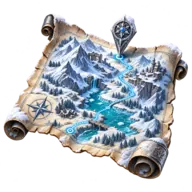
Icesus has cities, wilderness, dungeons and an interactive world atlas to help you orient yourself.
Build your own character.
Choose from 27 playable races, join a guild and train the skills it teaches. Each race and guild has its own strengths and requirements.
Besides humans and dwarves, you can play a thri-kreen, a mold man or a spell weaver.

Prepare before you go out.
Learn what you can handle, rest between fights, and take up crafting, hunting and trade when you want to.
What you can do in Icesus covers the rest.

The world of Icesus
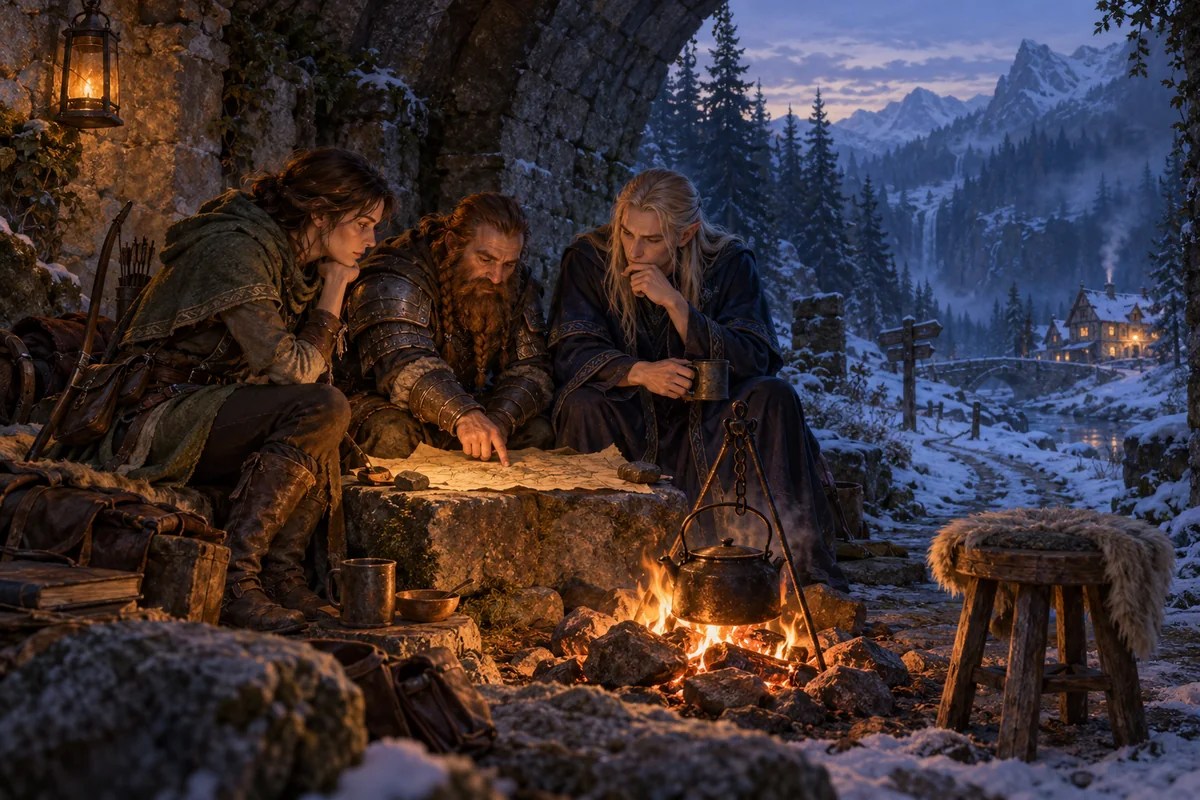
Icesus takes place in a valley sheltered within a frozen world, where volcanic warmth helps sustain life. Roads connect settlements; beyond them lie forests, wilderness and places you will learn to approach carefully.
The world map shows the valley, its cities and the roads between them.
Other players are online with you. You can start alone, ask questions on the newbie channel, and find a party for harder fights on the wanted channel.
Icesus began in 1995, and volunteers have been adding to the world ever since.
What the game looks like
This is the browser client: the game text, a map, your health and other resources, and movement buttons. Players on desktop MUD clients are in the same game.
Start in the browser. You can move to a desktop client later, or never.
Browser play guide →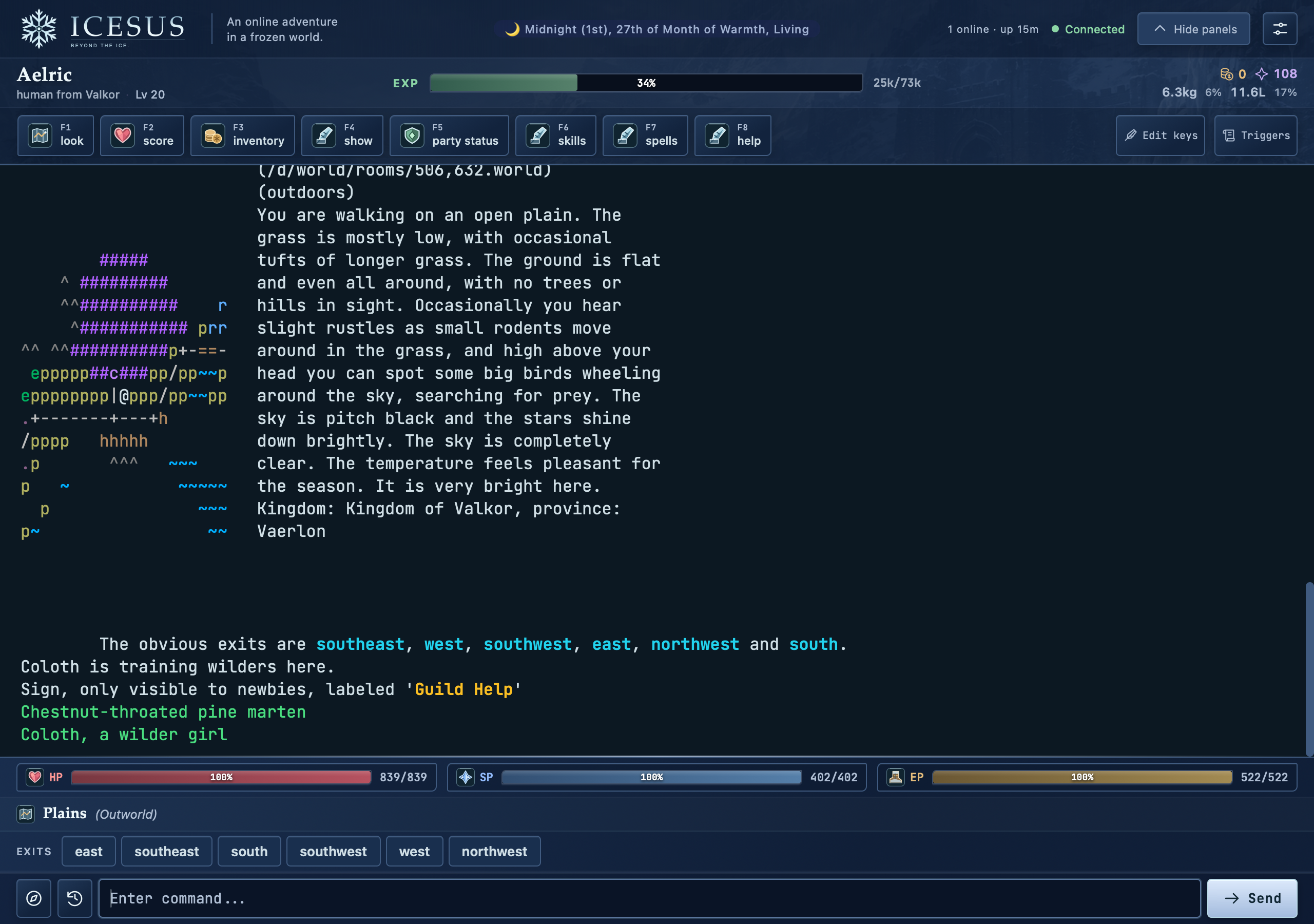
Text RPG, MUD or interactive fiction?
“Text-based RPG” covers several kinds of game. These are useful distinctions, though individual games often mix formats. The right choice depends on what you want to spend your time doing.
| Format | What you do | A good fit when you want… |
|---|---|---|
| Multiplayer MUD Icesus is here | Explore a shared world through commands, develop a character and interact with other players. | An ongoing RPG with familiar places, progression and a community. |
| Choice-based RPG | Select actions or dialogue options that shape an authored story and often your character’s abilities. | A guided narrative with clear choices and branching outcomes. |
| Parser-based interactive fiction | Type commands to inspect objects, solve puzzles and move through a story. | Close reading, discovery and puzzles, often as a solo experience. |
| Idle or incremental RPG | Develop a character or resources through repeated actions, timers and varying degrees of automation. | Progression you can check in on between other activities. |
| AI story RPG | Give prompts or actions to a system that generates narration; rules, saving and multiplayer vary. | Improvised storytelling shaped around your input. |
A MUD means “multi-user dungeon”. It is part of the history of online multiplayer worlds, and it remains a way to play today. Icesus belongs here: it has authored places and game rules shared by its players, with real-time encounters and long-term progression.
Choose Icesus if learning a world and a character over time sounds rewarding. If you want a short, self-contained story with a final chapter, a solo text adventure may suit that evening better. You can enjoy both.
Text RPGs you can play today
"Text RPG" covers games that have little in common beyond the medium. The table compares eight you can start today on the four things that most change what playing feels like: whether other people are in the world with you, whether the world persists, what it costs, and whether it runs in a browser.
| Game | Multiplayer | Persistent world | Free? | Plays in a browser |
|---|---|---|---|---|
| Shared worlds (MUDs) | ||||
| Icesus since 1995 |
Yes, live in one shared world | Yes | Free, nothing for sale; run by a non-profit | Yes, one click |
| Achaea Iron Realms, since 1997 |
Yes, live in one shared world | Yes | Free, with optional credits and an Iron Elite membership | Yes, the Nexus client |
| Alter Aeon since 1995 |
Yes, live in one shared world | Yes | Free; donations become in-game credits | No official client; free launcher or any MUD client |
| WrittenRealms in alpha |
Depends on the world: shared, or a private copy for each player | Yes | Free, no ads; supported on Patreon | Yes, browser only |
| Browser RPGs played through menus | ||||
| Torn since 2004 |
Massively, through attacks, factions and trade rather than shared rooms | Yes, never reset | Free, with optional donator packs and points | Yes, plus apps |
| Fallen London Failbetter, since 2009 |
Mostly solo, with social actions | Your character persists; the stories are your own | Free, with optional Fate and the Exceptional Friendship subscription | Yes, desktop or phone |
| AI text adventures | ||||
| AI Dungeon Latitude, since 2019 |
Optional: friends join a story with a code | No shared world; your stories save | Free tier; paid memberships | Yes, plus apps |
| Friends & Fables fables.gg |
A party of up to six | No shared world; your campaigns save | Free tier of 25 turns a day; paid plans | Yes, web app |
Icesus is our game. Every other row comes from that game's own site, help pages or store listing, checked on 4 October 2026. Friends & Fables is still online, but in August 2026 its developers moved their main effort to a new product, Craft. Plans and prices change, so check a game's own site before you pay for anything.
If you want other people in the world with you, the first group is where to look, and Best Browser MUDs goes deeper on it. For an improvised story of your own, try the AI games. For a wider map of the genre, from Zork-style adventures to games played over text messages, see Text-Based Games: The Six Kinds.
Text-based MMORPGs
A text-based MMORPG is what a MUD has always been: a persistent online world with many players in it at once, guilds, parties, a player economy and characters that grow over months and years. Graphical MMORPGs grew out of MUDs, and the text form never went away. What it gives up in graphics it gets back in breadth, because a new area needs writing and code rather than art. What Is a Multi-User Dungeon? covers the history.
Which text MMORPG is best depends on what you want from one:
- Nothing for sale, ever: Icesus or Discworld MUD. Both are free, run by volunteers and have no in-game store.
- Player politics, roleplay and the deepest PvP: Achaea, the flagship of Iron Realms. It is free to play, with optional credits for sale.
- Playing with a screen reader: Alter Aeon, where most players use one, or Icesus, which has a screen reader mode built in.
- Land to build and govern with other players: Icesus, where players run villages by council vote, trade provisions, cook for shared feasts and build houses and towers of their own.
For a first text MMORPG, Icesus is the one we would pick, as you would expect from its own site. It is free with nothing to buy, opens in a browser tab, is mainly PvE so you can learn without being hunted, and lets you rebuild a character through reincarnation instead of starting over. Best Browser MUDs and Best Free MUDs compare the field in more depth.
How to start playing Icesus
Create your character.
Open the character builder. Pick a race and a profession, then write your background and story. The builder explains each choice and its requirements.
You can explore before the account step, and an unfinished draft is saved in this browser. Your profession points you toward a path; you still join its guild in the world.
Play the tutorial.
Your first life begins at the Parson’s Head wayhouse. Alice, a travelling ranger, introduces conversations, everyday actions and an encounter before the road to Vaerlon.
Follow the prompts. Use
progressto check tutorial goals andrepeatto read the latest instruction again.Find your feet in Vaerlon.
In the city,
journeyshows your next guided step. Learn your way around and find the beginner activities before you head out into the wilds.Keep the step-by-step beginner guide beside you. It covers the tutorial, commands, first fights and how to leave safely.
Start with a name.
The builder walks you through the rest.
First commands
Type a command in the game’s command line and press Enter.
New characters start on the newbie channel. To ask other players for help, type newbie Hello, I am new. Where should I begin?
look- Read your surroundings again.
north- Move north, when that exit is available.
inventory- See what you are carrying.
score- Check your character’s information.
help newbie- Open the beginner help index.
journey- See your next newcomer guidance step.

What carries over between sessions
Your character, levels and skills carry over from one session to the next, and the world keeps running while you are away.
Death costs experience, so start with the fights the tutorial recommends, check what you carry, and learn when to retreat. Experienced players on the newbie channel can tell you what is safe.
Later, reincarnation lets you rebuild your character instead of starting over.
Free, and run by a non-profit
Icesus is run by Jää ry, a registered Finnish non-profit association, and maintained by volunteers. You can create a character and play without a subscription or required purchase. Optional support helps keep the project running.
Players can also help build the world: see contributing.
Devices and screen readers
The browser client works on a computer or a phone. A physical keyboard helps in longer sessions.
Icesus supports screen-reader play, including the in-game screenreader on setting. The accessibility guide explains the available options. Dedicated clients are another choice if you prefer your own logging, aliases or accessibility workflow.
Questions about text-based RPGs.
What is the best text-based MMORPG?
It depends on what you want from one. For a world with nothing for sale, Icesus and Discworld MUD are both free and run by volunteers. For player politics, roleplay and the deepest PvP, Achaea is the best known. If you use a screen reader, Alter Aeon and Icesus both build for it. Icesus is a good first pick: it is free, opens in a browser tab, is mainly PvE so you can learn without being hunted, and lets you rebuild your character through reincarnation instead of starting over.
What is a text-based RPG?
A text-based RPG is a role-playing game that describes places, characters and events mainly in words. You make choices through commands or menus, and develop a character through the game’s rules. Icesus uses short typed commands in a shared online fantasy world.
Can I play Icesus free in my browser?
Yes. The full game is free to play in your browser, with no download or subscription. Start with the character builder, then enter the game. Icesus is operated by Jää ry, a Finnish non-profit association, and maintained by volunteers.
Is a text RPG the same as a MUD?
A MUD, short for multi-user dungeon, is a kind of online multiplayer world commonly played through text. Many MUDs are RPGs. The wider text RPG category also includes solo adventures, choice-based stories and other formats. Icesus is a multiplayer fantasy MUD.
Do I have to be a fast typist?
You do not need touch-typing skills to start. Basic commands are short, and the browser client offers clickable exits and movement controls. Combat happens in real time, so paying attention and learning when to retreat still matter. Begin with the guided tutorial.
Can I play on a phone or an older laptop?
You can use the browser client on a phone or a computer without installing a game. A larger screen and physical keyboard can make longer reading and combat sessions more comfortable. Try the browser first; a dedicated MUD client is optional.
Can I play with a screen reader?
Icesus offers a browser client with screen-reader support and an in-game screenreader on command to adjust text output. Check the accessibility guide for settings and client options.
Can I explore alone, or do I need a party?
You can begin on your own and learn the world at your own pace. Other players share the world, and parties become useful for tougher adventures. Use the newbie channel for questions; you do not need to arrive with a group of friends.
Does my character disappear when I log out?
Your character and progression carry between sessions. To store your equipment safely, use leave game at an inn and read the game’s response before closing the client. While your character is new, the game walks you to an inn if you leave elsewhere. Death and equipment loss are still part of the game.
Is Icesus an AI-generated text adventure?
Icesus is a shared game with authored areas, established rules and other human players. An AI story game may generate narration around your prompts and may also save campaigns or support groups. In Icesus, everyone plays within the same persistent game systems.
How old do I need to be to play?
Icesus is for players aged 16 and over. You can explore character choices before the account step. Read the game rules and terms when creating your account.
More practical help: accessibility settings, game rules, terms and the beginner walkthrough.
Start playing
Make a character in the builder, then begin the tutorial
at the Parson’s Head wayhouse.
Free to play · No download · Explore your choices before the account step
Returning player? Open the game →